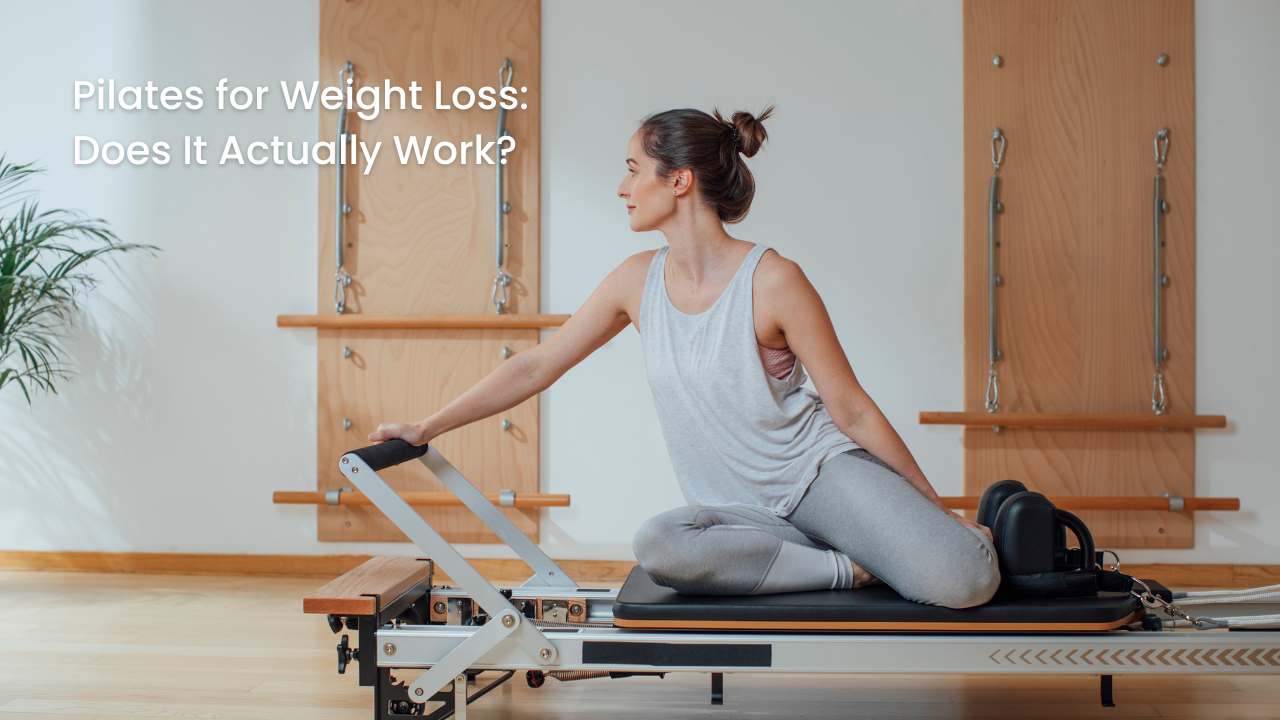
You’ve been showing up to class consistently, your core is stronger, your posture has improved — but you’re wondering whether Pilates for weight loss is actually a viable strategy, or whether you need to be doing something else entirely. It’s one of the most searched questions in the wellness space, and the answer is more nuanced — and more encouraging — than most fitness content gives it credit for. Yes, Pilates can meaningfully support fat loss and body composition change. But only if you understand what it does, what it doesn’t do, and how to structure it as part of a broader approach.
What Does the Research Actually Say About Pilates and Weight Loss?
The science here is genuinely interesting. A 2021 study published in the International Journal of Environmental Research and Public Health found that an eight-week Pilates programme significantly reduced body weight, BMI, and body fat percentage in overweight women — without any changes to diet. A separate review found that Pilates improved lean muscle mass and functional body composition across multiple age groups, particularly in women over 35.
What these studies consistently show is that Pilates produces meaningful body composition changes — particularly reductions in visceral fat and improvements in lean tissue — even when calorie burn per session is modest compared to high-intensity training. The mechanism isn’t purely caloric expenditure. It’s more sophisticated than that.
Why Pilates Changes Your Body Differently to Cardio
Traditional weight loss thinking centres on calories burned per session. By that metric alone, Pilates appears to underperform — a typical mat class burns roughly 175–250 calories, compared to 400–600 for a steady-state run. But this comparison misses several critical factors that make Pilates a powerful body composition tool.
- Muscle recruitment density: Pilates activates deep stabilising muscles — the transversus abdominis, multifidus, and pelvic floor — that most conventional gym training barely touches. More muscle tissue engaged means a higher resting metabolic rate over time.
- Eccentric loading: Pilates places significant eccentric demand on muscles (controlled lengthening under tension), which is particularly effective at stimulating lean muscle development — the tissue that drives long-term fat burning.
- Hormonal environment: The low-cortisol, mindful nature of Pilates practice supports a healthier hormonal profile. Chronically elevated cortisol from overtraining or high-stress lifestyles actively promotes fat storage, particularly around the abdomen.
- Movement quality and consistency: Pilates builds the kind of body awareness and injury resilience that keeps you training consistently over months and years — and consistency, not intensity, is the true driver of lasting body transformation.
Reformer vs Mat Pilates: Which Is Better for Fat Loss?
As an intermediate practitioner, you’re likely working across both formats — and both have a role to play in a fat loss-focused programme. The key difference lies in resistance and progressive overload.
Reformer Pilates for Body Composition
The reformer’s spring resistance system allows you to progressively increase the load placed on working muscles in a way that mat work simply cannot replicate. This progressive overload stimulus — the same principle that underpins effective strength training — is critical for building lean muscle and, by extension, elevating your resting metabolism.
For body composition goals specifically, reformer sessions that incorporate higher spring resistance on lower body exercises — footwork series, leg press variations, long box pulling straps — will produce the greatest metabolic stimulus. Think of your reformer practice less as stretching with a machine, and more as precision resistance training with full-range mobility built in.
Mat Pilates for Fat Loss: Maximising the Stimulus
Mat Pilates can absolutely contribute to body composition change — provided you’re working at sufficient intensity. At an intermediate level, this means moving beyond the basics and incorporating exercises that create genuine muscular challenge: long lever variations, loaded progressions, and reduced rest time between exercises to elevate heart rate.
Adding a dedicated Pilates cardio flow to your mat practice — sequencing exercises like the hundred, double leg stretch, and scissors with minimal rest — can push heart rate into the 60–75% maximum range, meaningfully increasing caloric expenditure while preserving the postural and alignment benefits of classical Pilates.
How to Structure Your Pilates Practice for Maximum Fat Loss
The single most common mistake intermediate Pilates practitioners make when targeting body composition is under-dosing. Two gentle mat classes a week, however technically precise, will not produce a significant fat loss stimulus. Here’s a framework that will.
Recommended Weekly Structure
- 2 x Reformer sessions (resistance-focused): Prioritise spring-loaded lower body and full-body exercises. Push spring resistance progressively week on week. These sessions are your primary lean muscle stimulus.
- 1 x Mat Pilates cardio flow (45–60 minutes): Higher tempo, minimal rest, advanced progressions. This session drives caloric expenditure and aerobic capacity.
- 1 x Complementary session (your choice): A Pilates barre class, a moderate-intensity walk or cycle, or a functional strength session. This is your metabolic top-up without accumulating excessive fatigue.
At this frequency — four sessions across the week — you create a training stimulus significant enough to drive measurable body composition change over a 10–12 week period, while remaining sustainable and injury-free.
Progressive Overload in Pilates: The Principle Most People Miss
Progressive overload is the cornerstone of any effective body transformation programme. In Pilates terms, this means systematically making your practice harder over time — not just more precise. For intermediate practitioners, practical ways to apply this include:
- Increasing spring resistance on the reformer by one setting every 2–3 weeks on key exercises
- Progressing from bent knee to long lever variations in mat work (e.g., moving from single leg stretch to scissors to double straight leg lower)
- Reducing rest periods between exercises to increase cardiovascular demand
- Incorporating ankle weights or resistance bands in mat sessions for added load
- Transitioning from supported to unsupported variations (e.g., removing the reformer footbar for balance-dependent exercises)
The Nutrition Piece: What Pilates Alone Cannot Do
This section matters, and good-quality content should be honest about it. No training modality — Pilates included — can fully override a caloric surplus. If fat loss is your goal, your nutrition environment needs to support it.
That said, the relationship between Pilates and nutrition is more interesting than simple calorie arithmetic. Regular Pilates practice has been shown to improve interoceptive awareness — the ability to accurately read internal body signals — which translates to better hunger and satiety recognition, reduced emotional eating, and more intuitive relationship with food over time. Many practitioners report that consistent Pilates practice naturally moderates appetite and food choices, not through restriction, but through heightened body connection.
As a practical starting point, focus on:
- Adequate protein intake (1.6–2.2g per kg of bodyweight) to support lean muscle development and preserve muscle tissue during fat loss
- Meal timing around sessions — a small protein and carbohydrate combination within 60 minutes post-reformer session supports muscle protein synthesis
- Avoiding chronic under-eating — too large a caloric deficit suppresses the metabolic adaptations that make Pilates effective as a body composition tool
Realistic Timelines: What to Expect and When
Body composition change through Pilates is real — but it operates on a different timeline to high-intensity methods, and the results often look different too. Rather than dramatic scale weight drops, most practitioners report changes in how their body looks and functions: clothes fitting differently, a more defined waist, improved muscle tone, better posture that makes the entire silhouette appear leaner.
With a structured four-session weekly programme and aligned nutrition, most intermediate practitioners begin to notice measurable body composition changes between weeks 6 and 10. Significant transformation — the kind that shows clearly in photographs and body measurements — typically emerges at the 12–16 week mark. This is not a slow result; it is a lasting one.
Conclusion: Pilates Works — If You Work It Right
Pilates for weight loss isn’t a myth, a marketing claim, or a compromise. It’s a genuinely effective body composition tool — provided you approach it with the same strategic intent you’d bring to any serious training programme. For intermediate practitioners, that means progressive overload on the reformer, intensity-driven mat sessions, consistent weekly volume, and nutrition that supports your goals rather than undermining them.
EXTERNAL SOURCE SUGGESTIONS
- Tolnai, N. et al. (2016) — “Physical and Psychological Benefits of Once-a-Week Pilates Exercises in Young Sedentary Women” — PubMed, supports lean muscle and body composition claims. 🔗
- de Oliveira et al. (2021) — “Effects of Pilates Method in Body Composition” — International Journal of Environmental Research and Public Health 🔗
https://www.ncbi.nlm.nih.gov/pmc/articles/PMC8393491/
https://pubmed.ncbi.nlm.nih.gov/27474496/